One of the key learnings from successful product launches is that successful launch teams relentlessly measure performance and outcomes.
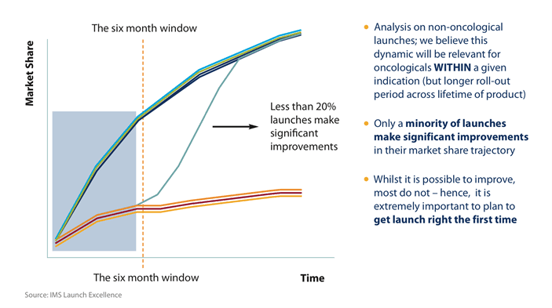
There is a 6-month window following approval where opportunity exists to ensure the initiatives that were implemented to drive the market uptake are performing as expected.
For 80% of launches, what happens during this window influences performance for the next 5 years. Measuring how these initiatives are progressing is vital in order to make the necessary course corrections when challenges arise.
Key Performance Indicators (KPIs, for short) are metrics (indicators) that are directly aligned with your business goals (key), and measure how successful (performance) you are at achieving your objectives. Well-defined KPIs are a valuable form of communication on an internal level and to important stakeholders, but they are really only as valuable as the action they inspire.
Determining the most optimal KPIs requires focusing on metrics and goals specific to your unique organization and product. The ability to track and analyze this data is the best way to inform where improvements can and should be made.
Two Types of KPIs
Leading KPIs
Leading KPIs influence future performance. These KPIs indirectly inform future market share and financial performance of a brand. Example: Customer satisfaction points to future revenue – because satisfied customers are more likely to repurchase and tell their friends.
Lagging KPIs
Lagging KPIs analyze past performance. These KPIs directly measure market share or financial performance of a brand. Examples: Revenue, growth, and market share.
Common Challenges
We commonly see certain challenges in developing KPIs, especially as organizations do this for the very first time. Challenges arise when companies:
- Don't link their KPIs to their strategy
- Only measure what is easy to measure
- Collect the same measures as everyone else
- Are not analyzing KPIs to extract insights, and
- Don't act on their KPIs
A recurring theme here is the importance of prioritizing alignment on your organization’s strategy and the goals and objectives required to fulfill it. Well-defined KPIs will be uniquely tailored to your organization and made to serve your product alone.
Where to Start: Example of KPI Development
Reviewing your strategic objectives, the objectives you have aligned to your strategy, is a good starting point for defining your KPIs.
Your first step is to determine which initiatives will be executed against your specific objectives. Once you’ve determined an initiative, you will be able to define the KPIs that can be measured toward that initiative. Then, you can determine where the data comes from to calculate the KPI and the frequency at which the KPI will be measured.
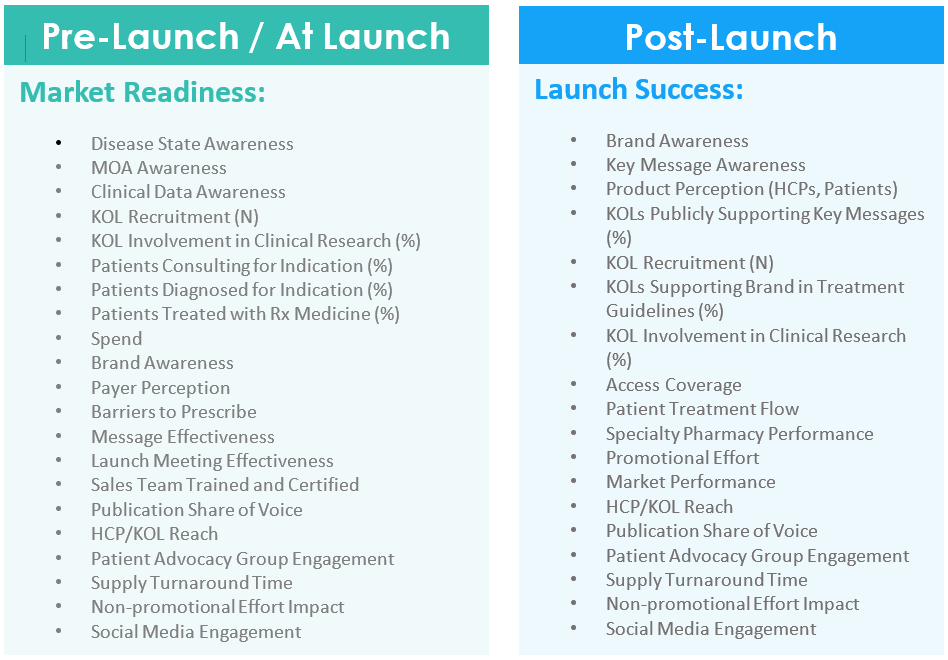
Click the button below the graphic to download examples of Pre-Launch, At Launch, and Post-Launch KPIs.