<img height="1" width="1" style="display:none;" alt="" src="https://px.ads.linkedin.com/collect/?pid=1549393&amp;fmt=gif">

What’s new in data strategy and why it matters now

From the Data Desk

Data projects often begin with a reasonable request to copy information into another location for analysis. While the copy solves an immediate problem, it also creates another location to secure, refresh, reconcile, and eventually retire.

Recent data-platform releases point toward a different operating model. Open table formats, shared catalogs, and cross-engine controls are making it more practical for different tools to work with the same underlying data. That shifts the question from how to move another copy to whether a governed source can serve more than one tool. Compatibility is not automatic, and some capabilities remain in preview.

The business question is less about which vendor wins and more about where information should live, who can use it, and how control survives as new tools are introduced. A recent UK government survey also highlights the differences between possessing data, analyzing it, and sharing it. Together with October's platform developments, the findings help frame how organizations can make data reuse more deliberate, trusted, and useful.

As always, the goal is clarity over coverage.

In the Data

The data-copy decision is changing

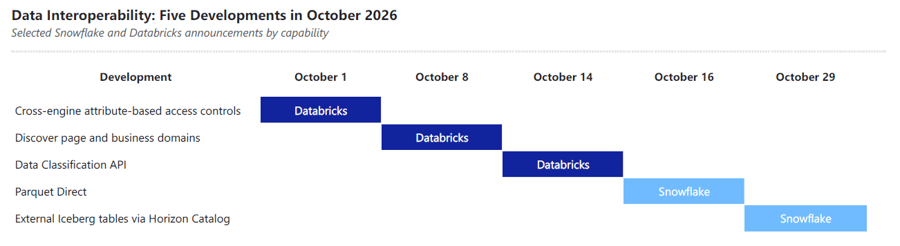
On October 29, Snowflake made a new data-sharing capability generally available, allowing supported external analytics tools to work with certain Iceberg tables through a shared catalog. Rather than maintaining separate copies for every tool, organizations may be able to provide access to the same underlying data while applying centralized permissions. Some security capabilities remain in preview, so organizations still need to validate which controls apply.

Earlier in the month, Snowflake introduced Parquet Direct in preview. It allows existing Parquet files in cloud object storage to be registered as read-only Iceberg tables without copying or rewriting the files. That is a different capability from the October 29 general-availability release, and the preview label matters.

Databricks announced cross-engine attribute-based access controls as generally available on October 1. Supported external engines can read managed tables with row filters and column masks enforced through Databricks serverless compute. Although the underlying technologies differ, both companies are developing ways to extend data access and security policies beyond a single query interface.

These announcements do not prove that data movement is obsolete or that the platforms are interchangeable. Performance, cloud costs, permissions, data contracts, and support requirements still need testing. They do show a shift from moving every dataset toward each tool to asking whether more tools can safely work from governed shared assets. Related announcements on data discovery and classification show how vendors are approaching this challenge from several angles. Their efforts span data access, usability, and governance.


Data Interoperability_Five Developments in October 2026


Sources: Snowflake, External Iceberg tables through Horizon Catalog (GA); Snowflake, Parquet Direct (preview); Databricks, October 2026 product release notes


Data use is not the same as data availability

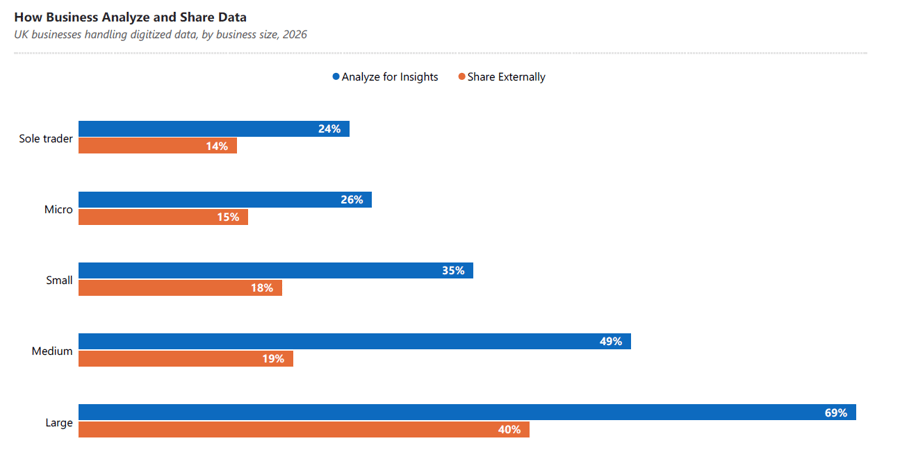
Technology can make data easier to access, but access alone does not guarantee that organizations will use it effectively. The UK Business Data Survey 2026 provides a broader view of how businesses work with digitized data, including whether they analyze it for insights or share it externally. In the survey, 25% of businesses handling digitized data reported analyzing it to generate new insights, while 14% reported sharing data outside their organization. Among large businesses, those figures were 69% and 40%, respectively. The survey does not measure internal platform interoperability, but it shows that handling data, analyzing it, and sharing it are distinct activities. Making data available is only one part of the challenge. Organizations also need the skills, processes, and tools to put that data to effective use.

How Businesses Analyze and Share Data

Source: UK Department for Science, Innovation and Technology, UK Business Data Survey 2026

In Data

Open access is useful only when the rest of the operating model works

Discovery: Users must be able to find the governed version

Databricks made its Discover page and business domains generally available on October 8. The feature organizes assets such as tables, dashboards, notebooks, and AI/BI agents by business area and allows curation. This is not a universal catalog standard, but it addresses a practical problem: shared data has little value if people cannot find the right asset or understand whether it is trusted.

For business leaders, discovery is a governance question as much as a search feature. Which datasets are approved? Which definitions are current? Who is responsible for the asset? A common storage format does not answer those questions by itself.

Classification: The data still needs context and protection

On October 14, Databricks made its Data Classification API generally available, while automatic tagging configuration remained in public preview. The distinction is important. Identifying sensitive information is a different task from proving that access rules are correctly enforced across every tool and workflow.

As data becomes easier to reach from more engines, teams need stronger evidence that classification, masking, row-level access, logging, and exception handling behave as intended. Reuse should reduce uncontrolled copies, not multiply uncontrolled access paths.

Destination: The spreadsheet remains part of the equation

Databricks also introduced scheduled refresh for its Excel add-in in public preview on October 1. The release itself is relatively modest. Still, it addresses an important consideration for organizations investing in data platforms. Employees need to be able to use governed data within the tools they already rely on. The lesson is not that every Excel file should become a live connection. It is that the handoff from managed data to everyday analysis deserves the same design attention as the platform itself.

Actionable Insight

Before making another copy, run the reuse test

Most organizations cannot eliminate every extract, cache, warehouse, or local file, nor should they. Some copies are necessary for performance, disaster recovery, regulatory isolation, or offline work. The goal is to make duplication a deliberate design choice rather than the default response to every new reporting request.

1. Name the source of truth. Identify the governed dataset, business owner, technical steward, and approved definitions. If no one can name the source of truth, interoperability will spread confusion rather than resolve it.

2. Identify why a copy is being requested. Is the reason speed, access, tooling, transformation, resilience, or simply habit? A clear reason makes alternatives easier to evaluate.

3. Test access without movement. Check whether the consuming tool can query the data through a supported connector, catalog, or open format. Verify actual performance and permissions rather than assuming that a standards label guarantees compatibility.

4. Verify controls end to end. Test row and column restrictions, data classification, audit logs, service identities, and how policy changes propagate. A single successful query is not proof of governance.

5. Calculate the full copy cost. Include storage, refresh pipelines, data transfer, reconciliation, support, incident response, and the effort of explaining why two versions disagree. Compare that total with the performance and operating cost of shared access.

6. Choose a lifecycle. If a copy is justified, record its owner, refresh expectation, expiry or review date, and what happens when the source definition changes. Temporary extracts should not silently become permanent systems.

Start with one frequently copied dataset, such as customer, product, or sales history. Map every downstream copy and its reason for existing. Then select one low-risk consumer to test governed reuse. The measure of success is not the number of platforms connected. It is fewer conflicting versions, less maintenance, and no loss of control.


CLOSING

The October releases are not the end of data duplication. They are evidence that data access, discovery, and policy enforcement are being redesigned around shared assets. That brings an old management question back into focus. Are we copying information because the business needs a separate version, or because the systems were never designed to share it well? The answer shapes cost, trust, and the speed of future analytics work. Shared data only creates value when people know which information to trust and how to use it.

If any of this edition’s topics connect to challenges your organization is working through, we are glad to continue the conversation.


data@work is published by SVA Consulting. Each issue is designed to help business leaders understand what is changing in the data and analytics landscape, why it matters, and what to do with it.

Ready to transform your business?

Let’s chat! Just fill out the short contact form and our team will reach out shortly.
CONTACT US