
| Highlights: |
|
AI is having a moment. Every company is “exploring it,” every vendor is “powered by it,” and every strategy deck has at least one slide that basically says “we should probably be doing something with AI.”
But here’s the problem: most organizations don’t struggle with access to AI, they struggle with figuring out what to actually do with it.
So instead of starting with a grand, vague ambition like “transform the business with AI,” here’s a simpler idea: start with a practical use case. Focus on a specific process that’s slow, manual, or unnecessarily complex, and improve it.
That’s where AI begins to deliver real value.
A Real-World Scenario
Consider warranty validation in an industrial manufacturing environment.
When a product is returned for repair, the first step is determining whether it’s still under warranty. It sounds straightforward, but in practice, it rarely is.
Teams often need to:
- Locate the original sales record (sometimes through distributor channels)
- Verify product registration details
- Cross-check serial numbers
- Confirm purchase dates
- Interpret warranty policies and coverage rules
This information is typically spread across multiple systems: ERP platforms, partner/distributor data, and external sources. The process becomes time-consuming, dependent on individual knowledge, and difficult to scale.
And until it’s complete, the repair process can’t move forward.
Applying AI to a Real Workflow
Rather than treating this as a technology problem, it helps to look at it as a workflow problem: where is time being lost, and how can that be reduced?
In this case, I built a simple example to explore what that could look like in practice.
By connecting:
- Acumatica ERP data
- External data stored in Snowflake (such as distributor sales data)
- A large language model (LLM) like Claude
- A connectivity layer (in this case, CData Software)
…the system can automate much of the validation process.

What the System Handles
| 1. Aggregating Data Across Systems | Relevant information is pulled together automatically, removing the need for manual lookups. |
| 2. Validating Product Details | Serial numbers and registration data are cross-checked to ensure accuracy. |
| 3. Determining Warranty Eligibility | The system evaluates coverage based on purchase date and policy rules. |
| 4. Initiating the Process in ERP | Once validated, an RMA record is created directly in the ERP system. |
Why This Matters
This isn’t a flashy or experimental use case—it’s a practical one.
The value comes from improving a process that already exists:
- Reducing manual effort
- Increasing consistency
- Shortening turnaround times
- Allowing teams to focus on higher-value work
It’s a good example of how AI can fit into existing operations rather than requiring a complete overhaul.
Where to Start
If you’re looking to take AI further in your organization, it’s worth stepping back from the bigger-picture conversation and asking a few practical questions:
- Where are we relying heavily on manual processes?
- Which workflows require data from multiple systems?
- Where do delays create downstream impact?
Those are strong candidates for AI-driven improvement.
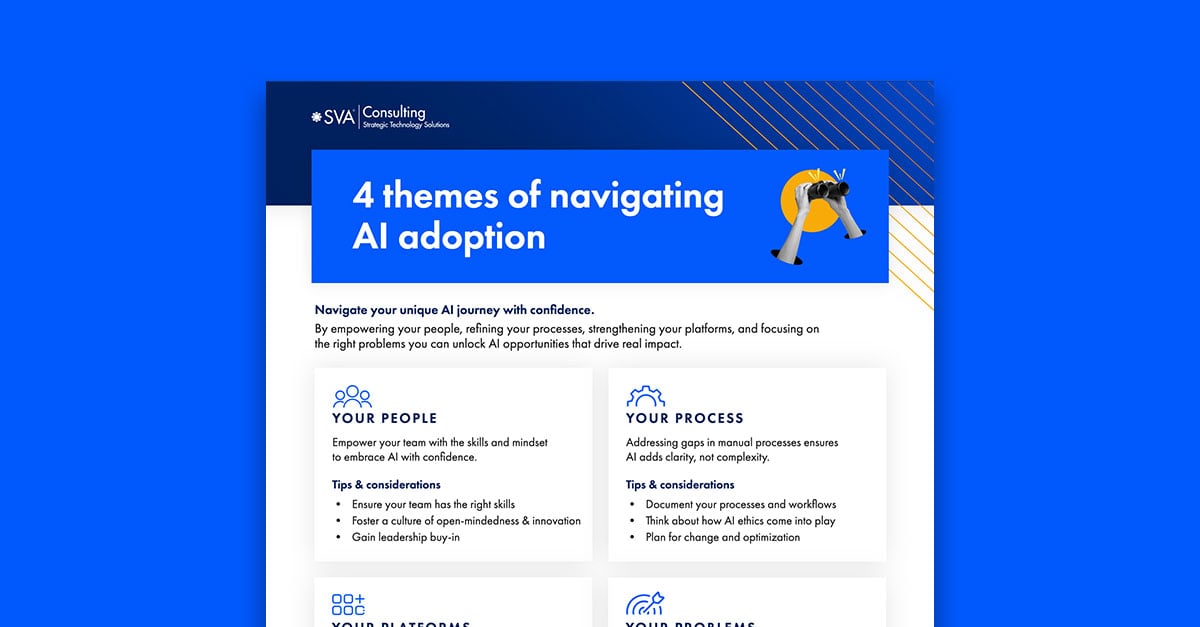
Because in the end, successful AI adoption isn’t about doing everything at once. It’s about identifying the right problems and solving them in a way that’s both practical and scalable.