

| Highlights: |
|
There is a certain kind of AI conversation we have all heard by now.
- "What model should we use?"
- "What is the newest tool?"
- "How do we add AI into this process?"
Those are fair questions. But after attending Snowflake Summit 2026, the conversation that stood out to me felt different. It was less about chasing the newest model and more about something much bigger: how do companies make AI useful, trustworthy, and part of the way work actually gets done?
That was the throughline of Snowflake Summit 2026. Snowflake framed the event around “making AI real for business,” and the announcements all pointed in that direction. The focus was not AI as a side experiment, a chatbot demo, or a proof of concept. It was AI as something that can support how companies build, govern, automate, analyze, and make decisions. Snowflake described the event as focused on helping enterprises move from AI experimentation to real-world deployment.

AI is Only as Strong as the Data Behind It
One of the clearest themes from Summit was that AI needs more than a powerful model. It needs a strong data foundation.
That sounds simple, but it is often the part that gets overlooked. If an AI system is working with incomplete, messy, outdated, or poorly governed data, the output may look confident while still being wrong. For a business, that is not just inconvenient. It can affect decisions, customer experiences, reporting, compliance, and trust.
Snowflake’s announcements around Horizon Catalog and Horizon Context were especially important here. The idea is to give AI systems access not only to data, but to the business meaning behind that data. That includes definitions, permissions, governance rules, and context that help people and AI systems work from the same understanding.
That’s a big deal because business data is rarely self-explanatory. A metric like “revenue,” “active customer,” or “pipeline” can mean different things across teams. Sales, finance, operations, and marketing may all use similar words but define them differently. If AI is going to help people make decisions, it needs to understand those differences.
This is where AI starts to feel less like a standalone tool and more like part of the company’s operating system.

AI Agents Are Getting Closer to Everyday Work
AI agents are different from basic chatbots. Instead of only answering questions, they are designed to help complete tasks, move between steps, and support decisions across workflows. They can help analyze information, generate recommendations, automate pieces of work, and connect the dots across systems.
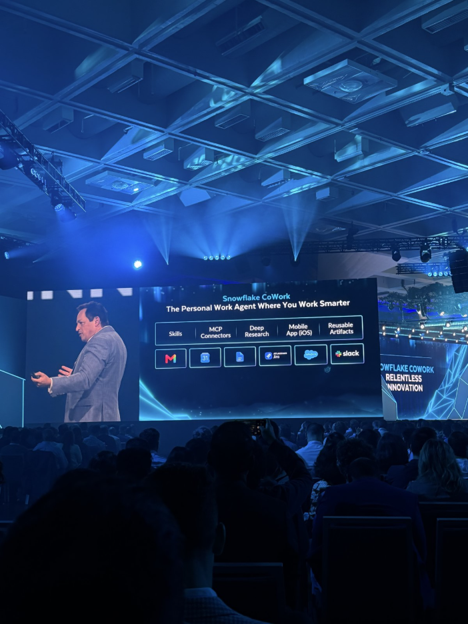
At Summit, Snowflake highlighted CoWork and CoCo as part of this push. CoWork (previously named Snowflake Intelligence) is aimed at helping business users work with data and take action more naturally. CoCo is geared toward technical teams, helping developers and builders move faster.
The message is clear: Snowflake wants to serve both sides of the enterprise AI equation. CoWork is for business users who need action from data. CoCo is for builders who need to create, automate, and deploy faster.
Imagine a sales leader asking an AI agent to prepare for a customer meeting, not by pulling from one static report, but by looking across account history, product usage, support tickets, pipeline data, and recent activity. Or imagine a technical team using an AI assistant to help build data workflows faster, while still staying within company governance and security rules.
The exciting part is not just that AI can answer a question. The exciting part is that it can start helping with the work around the question.
A Real Example: Sanofi's Assistant for Sales Rep
To show what production AI looks like, the pharmaceutical company Sanofi presented an assistant it built called "Concierge for Field." It prepares the company's sales representatives for visits with physicians. The assistant reviews prescribing history and past interactions, identifies which doctors to prioritize, drafts a ready-to-use plan, and emails it to the rep. Preparation that used to take hours now takes seconds.
That is CoWork in action. Rather than handing the rep another dashboard to dig through, the assistant does the digging and delivers a finished, usable result. Sanofi's chief digital officer put it plainly on stage: for years his teams had been building complicated systems just to get at their own data, and Snowflake let them build the AI directly on top of it instead.
Sanofi is an enormous enterprise, but what struck me is how cleanly the pattern scales down. The lesson isn't the size of the company. It's the shape of the problem: a specific, repetitive, time-consuming task handed off to an assistant so the person can focus on the part that actually needs them, which in this case is the conversation with the doctor. That shape exists in organizations of every size, in nearly every department.
Trust and Control: Governance Moves to Center Stage
Governance doesn’t always sound exciting. But at Summit, it felt central to whether AI can actually scale.
If companies want AI to move beyond experimentation, they need confidence in how it is being used. Who can access what data? Which systems can an agent act on? What business definitions should it follow? How do teams make sure sensitive information is protected? How do they trace where answers came from?
These are not small details. They are the difference between a cool demo and something a company can actually rely on.

One Trusted Home for Your Data
Several announcements centered on letting organizations work from a single, shared, well-governed copy of their data instead of scattering copies across many systems. This sounds like plumbing, and it is, but the business consequences are real. When every tool, dashboard, and assistant keeps its own copy of the data, the result is higher cost, ongoing confusion about which version is correct, and steadily eroding trust in the numbers.
Snowflake's updates here keep data in one dependable place while still letting different tools reach it when they need to, including modern open standards that prevent companies from being locked into a single vendor's format. For an organization that wants to use AI without first untangling years of duplicated spreadsheets and disconnected systems, this is the kind of foundation that makes everything built on top of it more reliable.
Open Data Matters Because Companies Don't Live in One System
Another topic that came up strongly was interoperability, or in simpler terms, making data easier to use across different platforms and tools.
Most companies don’t have all their data neatly sitting in one place. It is spread across cloud platforms, business applications, data lakes, warehouses, dashboards, and operational systems. That creates a problem for AI. If AI needs trusted, current, connected data, then silos become a major blocker.
Snowflake’s focus on Apache Iceberg and open data architecture was aimed at reducing that friction. Apache Iceberg is an open table format that helps organizations work with large-scale data across different systems. The bigger idea is that companies should be able to access and govern data without constantly copying it, duplicating it, or locking it into one place.
That may sound technical, but the business value is easy to understand: less duplication, fewer silos, and more consistent access to the data AI needs.
What This Means for You
You don’t need to act on any single product from this event. The useful signals are larger than that, and they hold regardless of which technology your organization eventually chooses.
Your Data is the Real Asset
The keynote thesis applies to companies of every size: the AI model is a commodity, but your organized, trusted, accessible information is not. The organizations getting real value from AI are the ones that invested in this foundation first. A good opening question for any AI project is not "which tool should we buy?" but "is our underlying information in good enough shape to build on?"
Start with One Job
Sanofi did not try to automate everything at once, and neither should you. Pick a specific, time-consuming task and point AI at it. There is almost certainly an equivalent in your work: the recurring prep, the manual report, the research that precedes every meeting. One clear win builds the confidence and credibility to take on the next.
Insist on Context and Accountability
The lesson of Cortex Sense is that an assistant without your business context produces fluent nonsense, and the lesson of AI Agent Identity is that an assistant taking action needs an owner. When you evaluate any proposal, ask two questions: where does this tool get its understanding of our business, and who is accountable for what it does?
Match the Ambition to the Team You Have
The most encouraging news from Summit is that capable AI is no longer reserved for organizations with large technical departments. Tools built for everyday users mean a focused team can take on far more than its size would suggest. The work now is less about hiring engineers and more about defining, clearly, what you want these tools to take off your plate.
The throughline of Summit 2026 is how concrete the conversation has become. The technology is increasingly built for the people who do the everyday work of a business, with the explicit aim of clearing the routine so they can spend their time where only a person can add value.
That is a future worth preparing for, and the encouraging part is that preparing for it starts with steps any organization can take today.
